The Biggest Mistake People Make When Learning AI
Every week, a new AI framework appears, a new model tops the benchmarks, and a new agent platform promises to automate everything. As a result, many aspiring AI engineers spend months learning prompts, frameworks, and tooling, only to discover later that they understand the interfaces but not the systems underneath them.
Six months into their journey, they can build demos. Yet they struggle to explain why a model overfits, how retrieval improves performance, why hallucinations occur, or what actually happens when a model is trained. The problem isn't a lack of intelligence. The problem is learning AI from the top down instead of the bottom up.
Most people start with what is visible: ChatGPT, agents, frameworks, and prompts. But those technologies sit on top of a much deeper stack built over decades of research in mathematics, machine learning, optimization, information retrieval, and systems engineering.
If you're getting into AI today, understanding this stack is one of the highest-return investments you can make.

Foundation 1: Mathematics, Statistics, and Learning Theory
Every AI system ultimately reduces to mathematical operations executed at scale. Embeddings are vectors, neural networks are compositions of matrix transformations, and training is an optimization problem involving millions or billions of parameters. You do not need a mathematics degree to build AI systems, but without mathematical intuition it becomes difficult to understand why models behave the way they do.
When embeddings cluster together, what does that actually mean? When a model performs perfectly during training but fails in production, why does it happen? When training becomes unstable, what exactly is going wrong? Mathematics and statistical learning provide the language needed to answer these questions rather than treating model behavior as a black box.

Where to Spend Your Time

Rigor Check: You should understand why semantically similar concepts appear close together in an embedding space, why gradients allow models to learn, and why a model can achieve excellent training performance yet fail to generalize to unseen data.
Foundation 2: Deep Learning and Transformers
Many newcomers treat ChatGPT as the starting point of AI. It isn't. Large Language Models are the result of decades of progress in neural networks, optimization, and representation learning.
The key breakthrough of deep learning was the ability to learn useful representations directly from data rather than relying on manually engineered features. Transformers extended this idea further through attention mechanisms, allowing models to identify which pieces of information matter most within a context. This seemingly simple innovation became the foundation for modern language models, coding assistants, multimodal systems, and many of today's most impressive AI applications.
Where to Spend Your Time

Rigor Check: You should understand how information flows through a neural network, how errors propagate backward during training, and why attention enables models to reason over long contexts more effectively than earlier architectures.
Foundation 3: LLMs, Retrieval, and Agents
A common misconception is that larger models automatically produce better AI systems. In reality, many successful AI products derive their value not from larger models but from better context.
A language model can only reason using the information available to it. If that information is outdated, incomplete, or missing entirely, even the most advanced model will struggle. This is why retrieval systems have become such an important part of modern AI. Retrieval-Augmented Generation (RAG) allows models to access relevant information at the moment a question is asked, grounding responses in current and domain-specific knowledge.
Agents build on top of this foundation. They do not create intelligence; they orchestrate it. A modern agent combines a language model with retrieval, memory, planning, tools, and workflows. What appears to be autonomous reasoning is often a carefully engineered system coordinating multiple capabilities toward a goal.
Where to Spend Your Time
Rigor Check: You should understand why a smaller model paired with excellent retrieval often outperforms a larger model operating without relevant context, and why sophisticated agent frameworks cannot compensate for poor grounding and retrieval quality.
Foundation 4: Systems Engineering and Scale
A model that works on your laptop is a prototype. A model that serves millions of users reliably is a product.
Academic papers focus on model quality and benchmark performance. Production environments care about latency, scalability, reliability, infrastructure costs, monitoring, and deployment constraints. This is where many AI projects succeed or fail.
The strongest AI engineers understand both algorithms and systems. They know how models learn, but they also know how to deploy, monitor, optimize, and scale those models under real-world constraints.
Where to Spend Your Time

Rigor Check: You should understand why memory constraints, serving costs, reliability requirements, and latency targets are often more important to product success than a small improvement in benchmark accuracy.
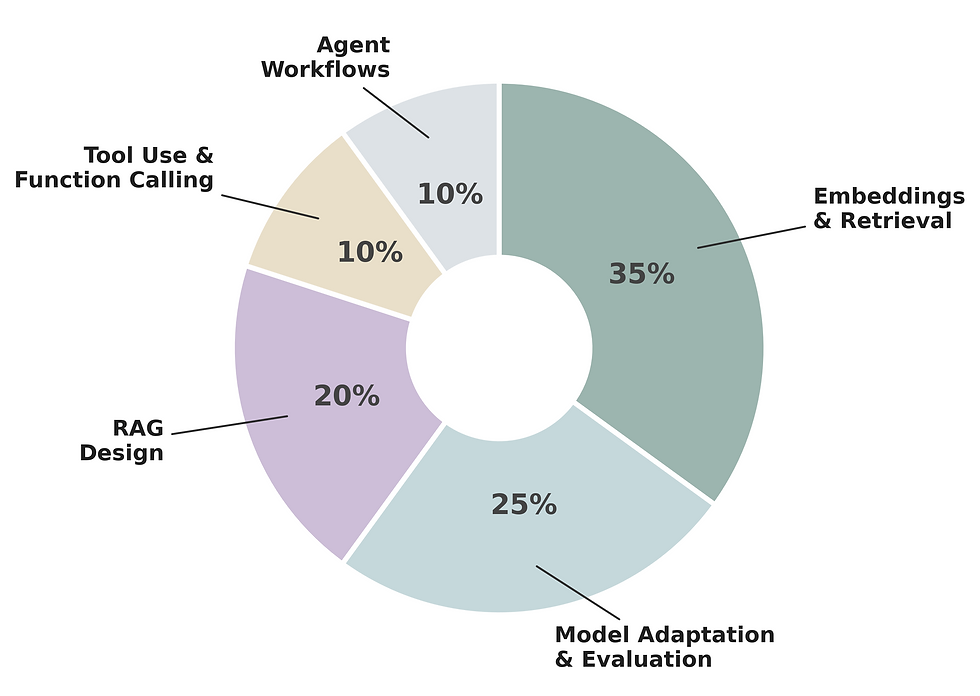
The AI Learning Allocation We Recommend in 2026
AI is a stack of knowledge, not just a tool or a model. The math, machine learning, deep learning, transformers, and infrastructure layers all work together. Notice what is missing from this list: prompt engineering, framework tutorials, and leaderboard chasing. These skills have value, but their half-life is short. The engineers who thrive over the next decade will not be the ones who mastered a particular framework first. They will be the ones who understand the principles that remain useful after the framework disappears.
Focusing on the foundations will give you a strong base to understand new tools and technologies as they emerge. This approach will help you build skills that last, not just follow trends. If you want to grow in AI, start with the stack. Build your understanding layer by layer. That’s how you gain the clarity and confidence to excel in your career.
If your goal is to build long-term expertise rather than chase short-term trends, a reasonable allocation of learning effort is:

At EntropyQ, we believe durable AI careers are built on foundations. Models will evolve, frameworks will change, and new abstractions will emerge. But a deep understanding of how models learn, how knowledge is retrieved, how intelligent systems are orchestrated, and how they are deployed at scale will remain valuable regardless of where the next breakthrough comes from.
This post is for informational purposes only and does not constitute professional advice.


Comments